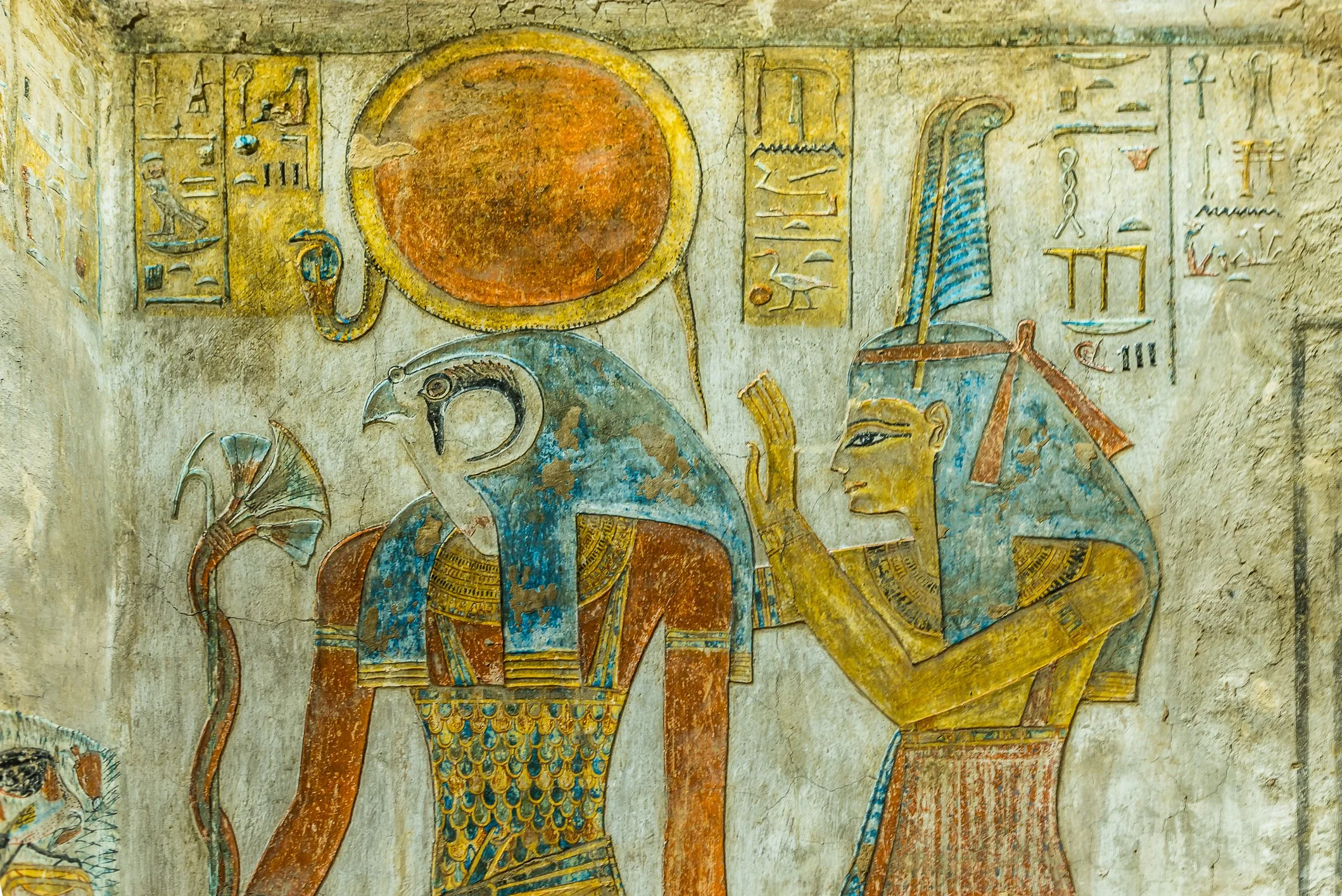
Ra, the Sun Deity
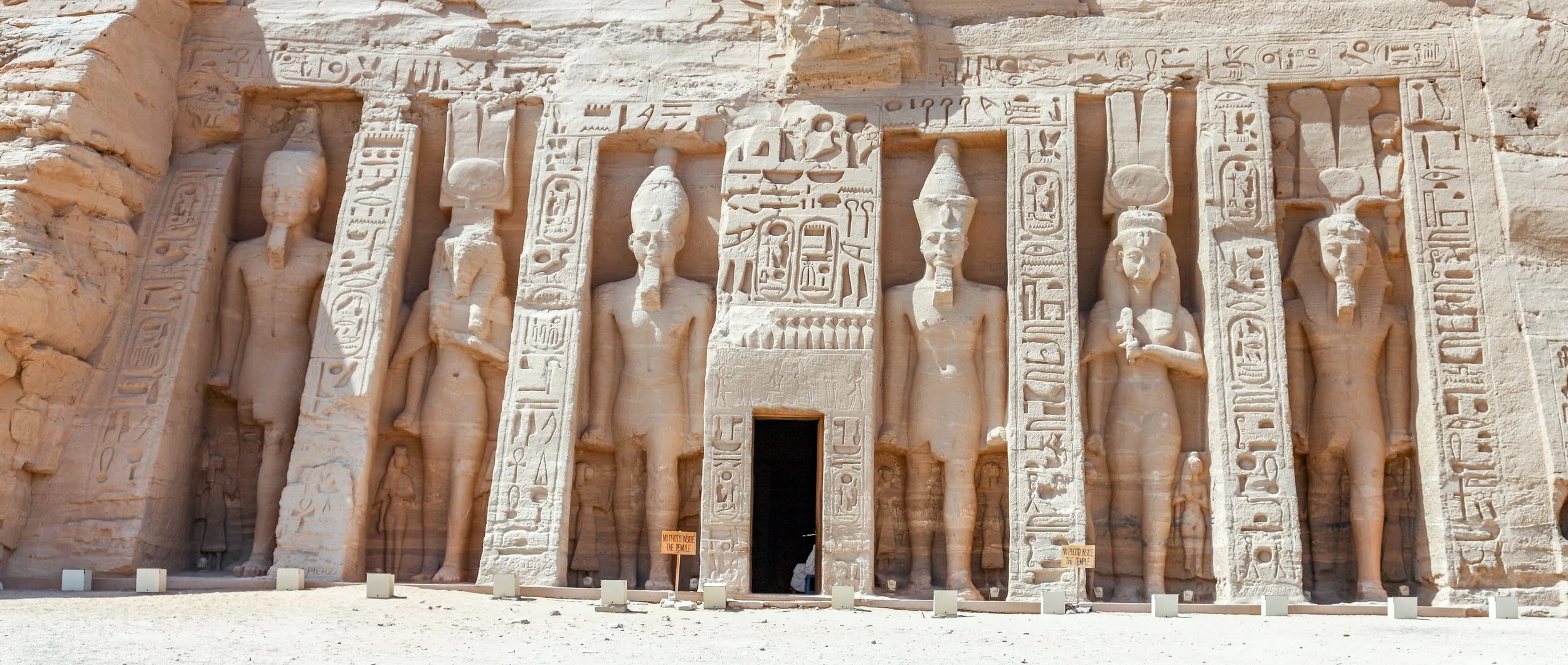
There are many versions of Ra. ‘Ra’ is the Egyptian word for the sun, and since we are talking of the Egyptian pantheon of gods, he was the oldest of them all and later merged with others such as Horus, becoming Ra-Horakhty (the morning sun), Amun (as noonday sun), and Atum (the evening sun) associated with primal life-giving energy. As a solar deity, he was the sun riding in his ship during the day and descending into the underworld come night.
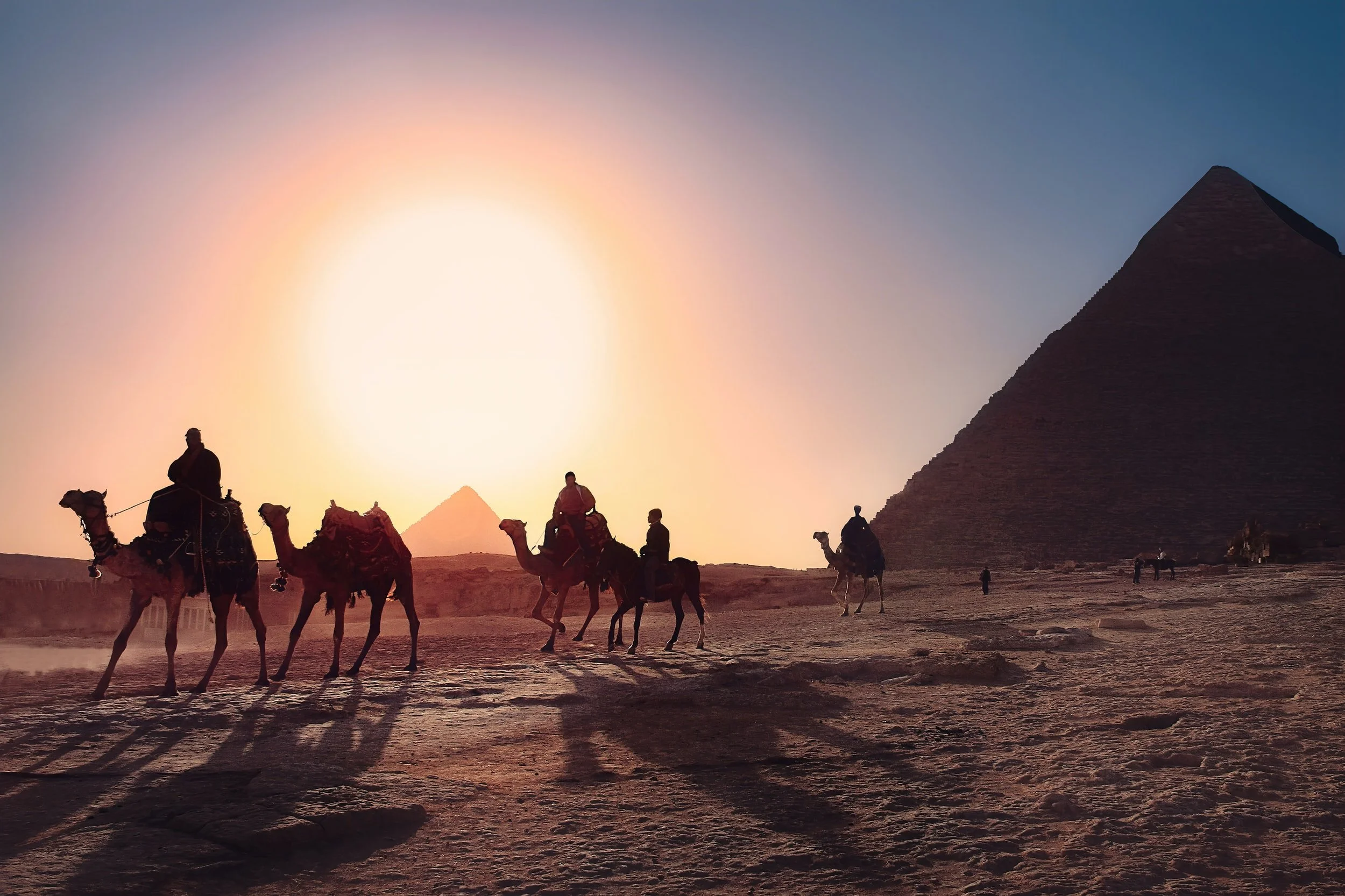
In Egyptian mythology, it is said he battles the giant serpent Apophis every time he goes to the underworld to start the end of the world and prevent the sun from ever-rising and destroying life on Earth forever. Ra was the most important god of Egypt and the most popular one, as he emphasized 'life-giving/bearing.' Worship of Ra was established in the Old Kingdom with the development of funerary rituals dedicated to the god. His image appeared on all royal monuments since the First Dynasty. Later emperors adopted the name “Ramses” as a religious title after the king's grandfather, who was also known as Ramesses I.
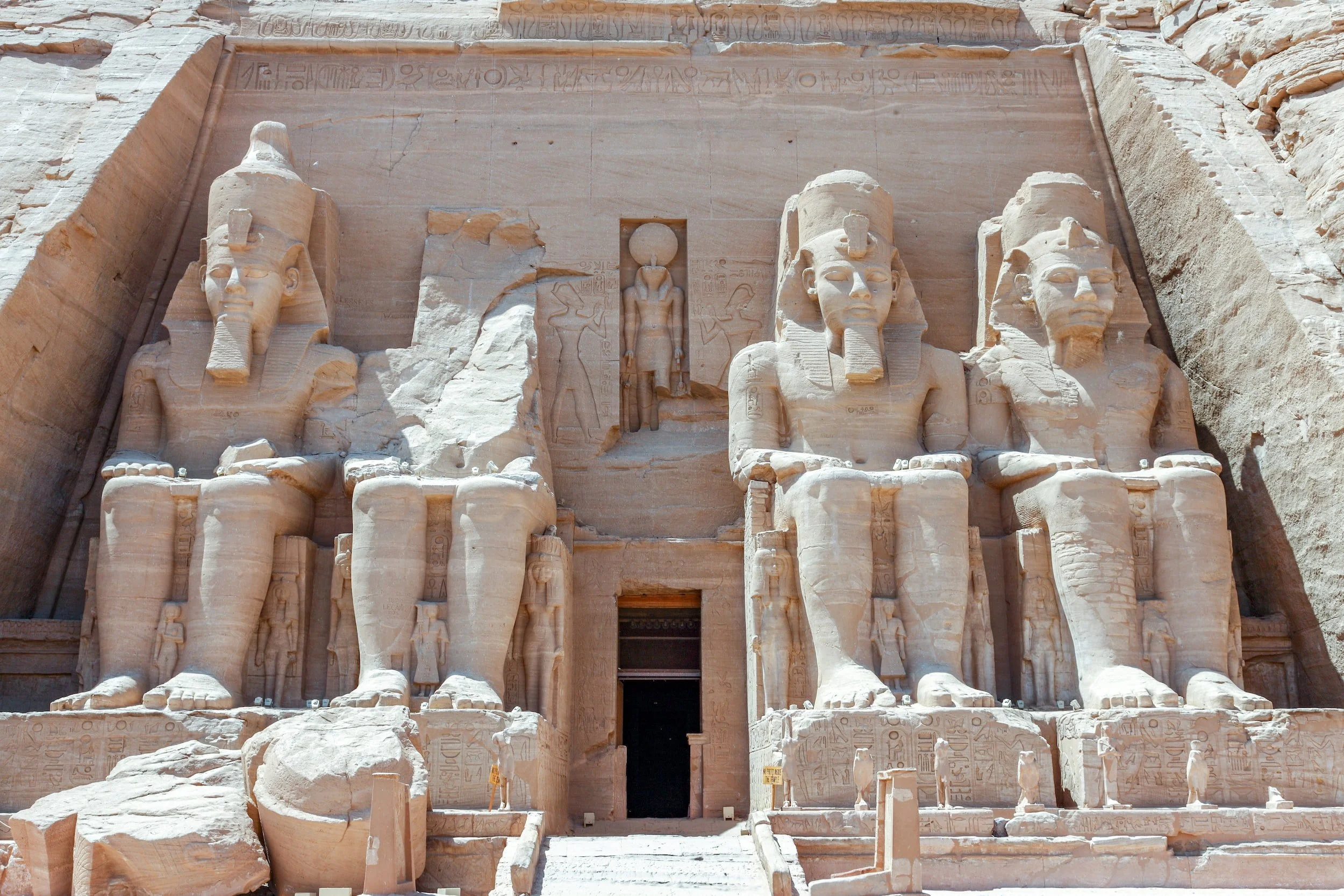
The most famous representations of Ra are is found on the Narmer Palette, a ‘‘hieroglyph of King Menes, which established Egypt’s first state religion around 3100 BC. The earliest known depiction of the god appears on one of the oldest surviving mummy masks, dating to the Middle Kingdom. This mask portrays the King wearing the headdress and chest ornaments that were worn by high priests of the temple of Ra during the Middle Kingdom period. Over time, the ram’s head symbol of Ra became widespread in Egypt, including appearing on the King’s banners and on temples as well as royal palaces.’’
Ra is a solar deity that is associated with light and rebirth. Throughout the history of mankind, the Sun has been considered the source of life for humanity, and therefore it has been used as a symbol by many religions to signify divinity. The Sun is associated with Ra because it is at his temple that the rays of sunlight would be most intense, shining on the statue of the god as if inviting him to shine on mankind. The ancient Egyptians believed that their civilization was founded by the gods of the sun. They associated the rising Sun with life and creation and used it to represent the passage of time – between each day and each month, the Egyptians measured the passing of time by counting the hours and minutes until the rising of the Sun again.
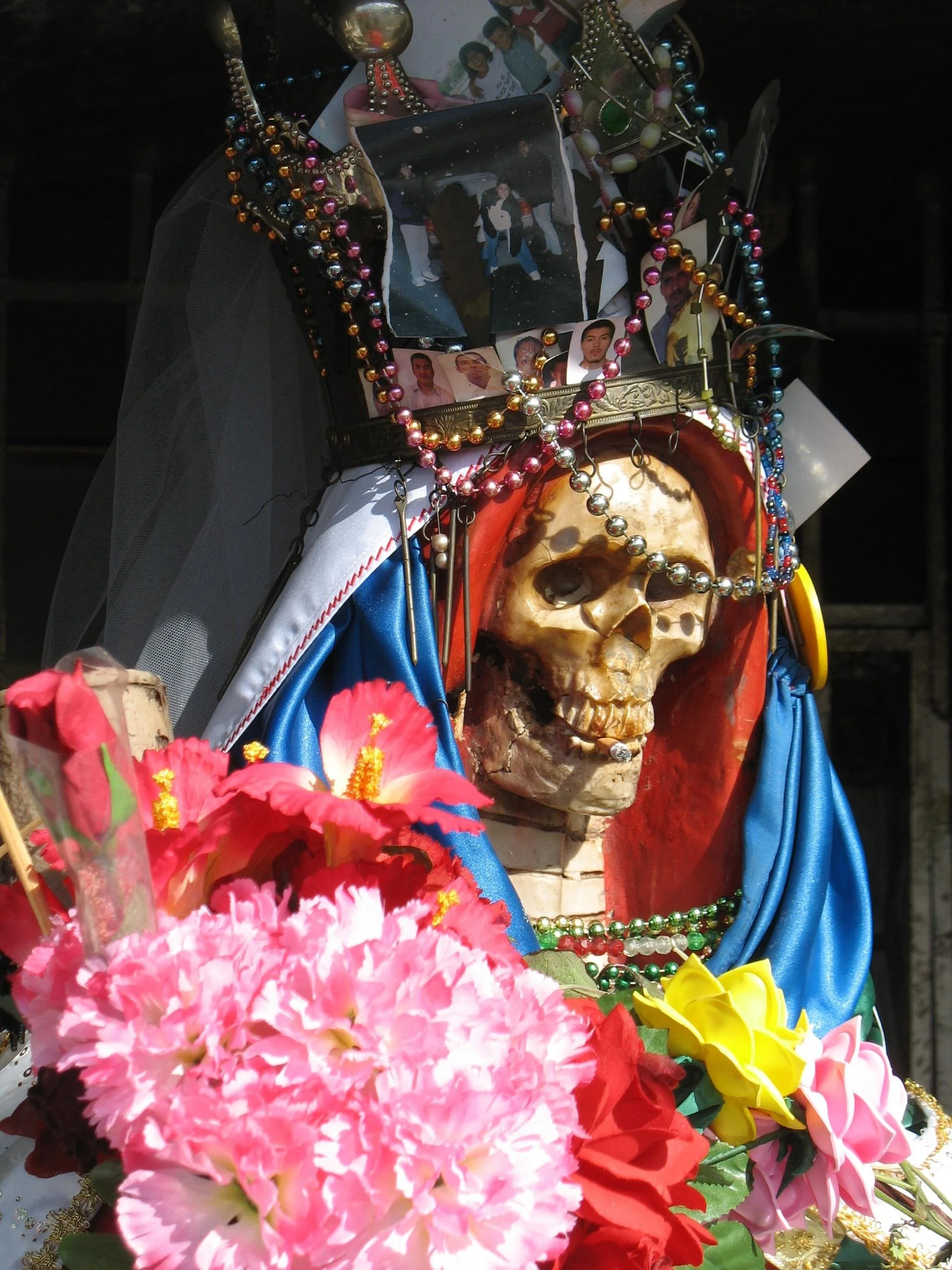
Santa Muerte
The history and celebration of Santa Muerte!
NO. 1
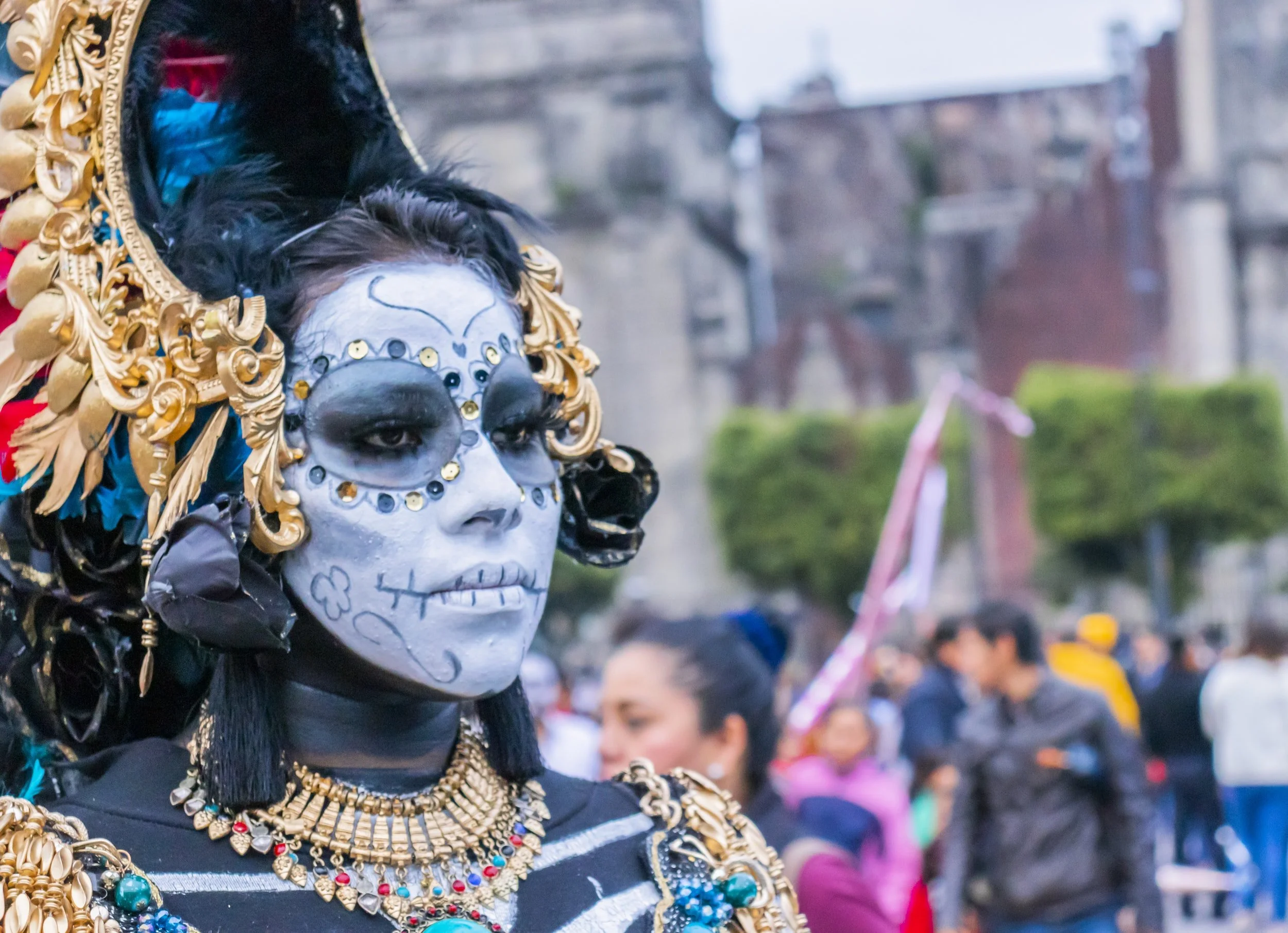
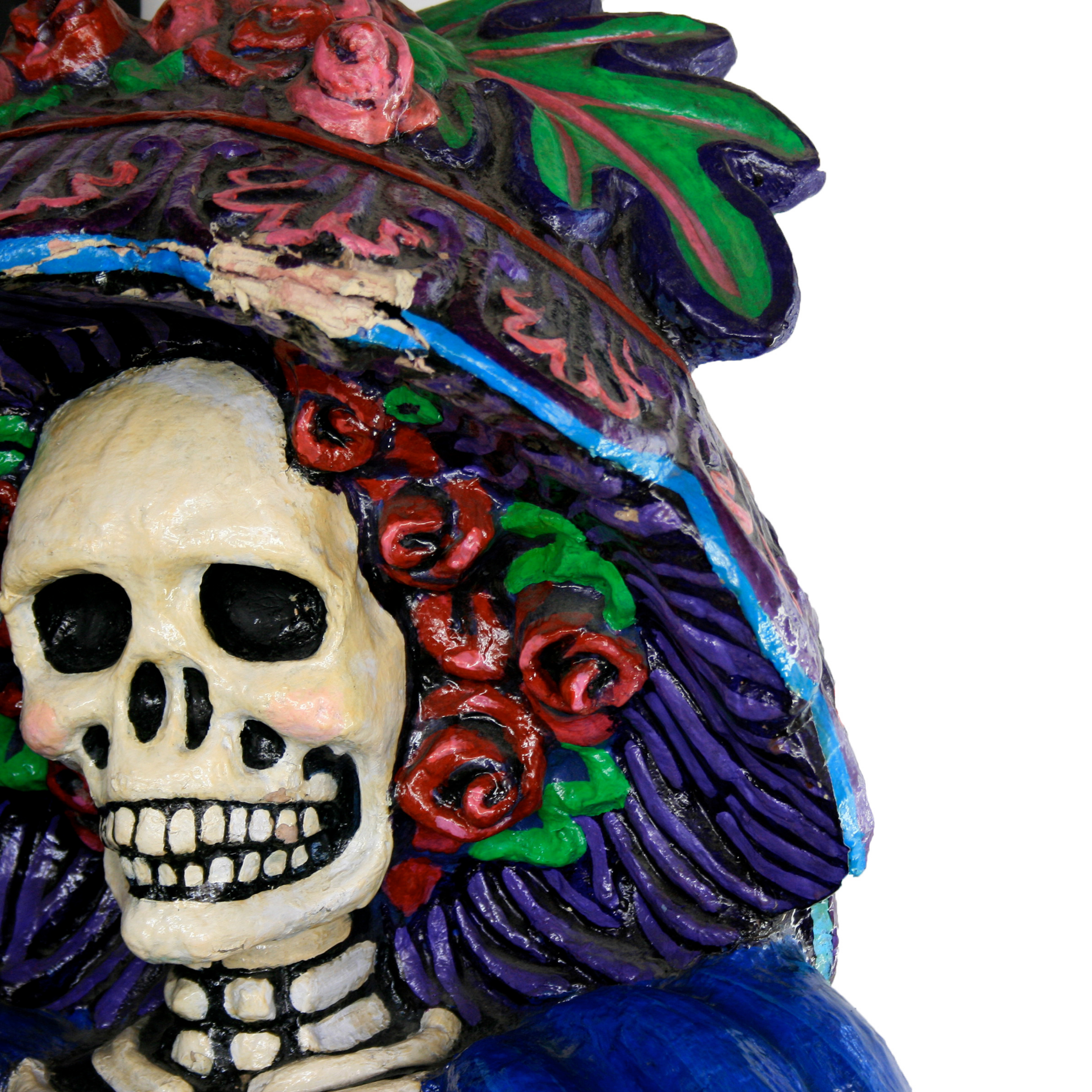
A skeletal figure dressed in robes or dressed in the virgin’s shroud, Santa Muerte is both the Grim Reap-ress and the Angel of Mercy. She is the personification of death, and her full title, Nuestra Señora de la Santa Muerte as she is well known as, brings an ambiguous and malleable identity that is associated with healing, protection, and safe delivery to the afterlife by her devotees, as her following, especially in 21st century is being celebrated all over South America, but especially Mexico City to the United States and Canada.
NO. 2
Even though Christian missionaries and leaders condemned the religion, Santa Muerte ‘‘offers hope to a society threatened with hopelessness. In the colorful barrios of Mexican culture, the figure of Death is ubiquitous. With the lure and dangers of narco-culture, the violence among competing youth gangs, the haunting realities of an economy in collapse, and the gravel fight to survive in a Tepito marketplace; Mexicans face the reality of death on a daily basis. Santa Muerte, the image of death, protects them from uncertainties in their everyday lives. When Death is the only guarantee, it seems like Death is the only one to be trusted.’’ The worship of Santa Muerte began in the mid-20th century and was clandestine until the 1990s, were most prayers and other rites have been performed traditionally at home. Now in the 21st century, worship has become a more public thing. Santa Muerte has a male counterpart in the U.S, called the skeletal folk saints San La Muerte of Paraguay and Rey Pascual of Guatemala.
NO. 3
So, what caused the worship of Santa Muerte to become a massive, worldwide following? Drug violence, for one, and loss of faith in Christianity. ‘‘Former Mexican president Felipe Calderon’s declaration of war on the cartels in 2006 was received with praise by North American politicians, as in their view, it seemed that the Mexican government was finally taking a strong stand against the cartels and that there would be a swift resolution to the social problems associated with drug trafficking. This open war declared on the cartels resulted in an escalation of drug violence and forced several dramatic changes in the safety of Mexico and its already chaotic social scene. Military personnel, paramilitary groups, and the cartels have been fighting for control of the country and have created a state of panic in the border towns and beyond. The panic and violence in the north have begun to gradually make it’s way south and reach areas that were once ‘safe’. According to the BBC from 2006 to 2012, more than 50,000 individuals have died from drug-related violence. Amidst the drug-related instability, the once strong and influential Mexican Catholic Church has been losing credibility, support, and members. The loss of faith in the Catholic Church could be caused by many factors: general pessimism, individuals searching for other forms of faith, and the result of the church’s support for governing political parties.’’

NO. 4
Who is Santa Muerte? Anthropologists and historians J. Katia Perdigon Castaneda and R. Andrew Chestnut agree that the veneration of Santa Muerte is a combination of Catholic imagery and rituals from Meso-American pre-Hispanic gods and rituals. There is a common list of names for the goddess, such as Mi Nina, (My little girl), La Nina Bonita (the Pretty Girl), La Madrina (the Godmother), and Mi Amor (My Love)—adoring names that tighten the relationship between devotee and saint. There are darker allegations like Senora de la Sombras (Lady of the Shadows) or La Negra (the Black Lady). There is also La Hermana Blanca (The White Sister) and Hermana de la Luz (Sister of the Light). She is celebrated on the Day of the Dead, November 1st and 2nd. better known as Dia De los Muertos.

Thoth's Prophecy of Egypt
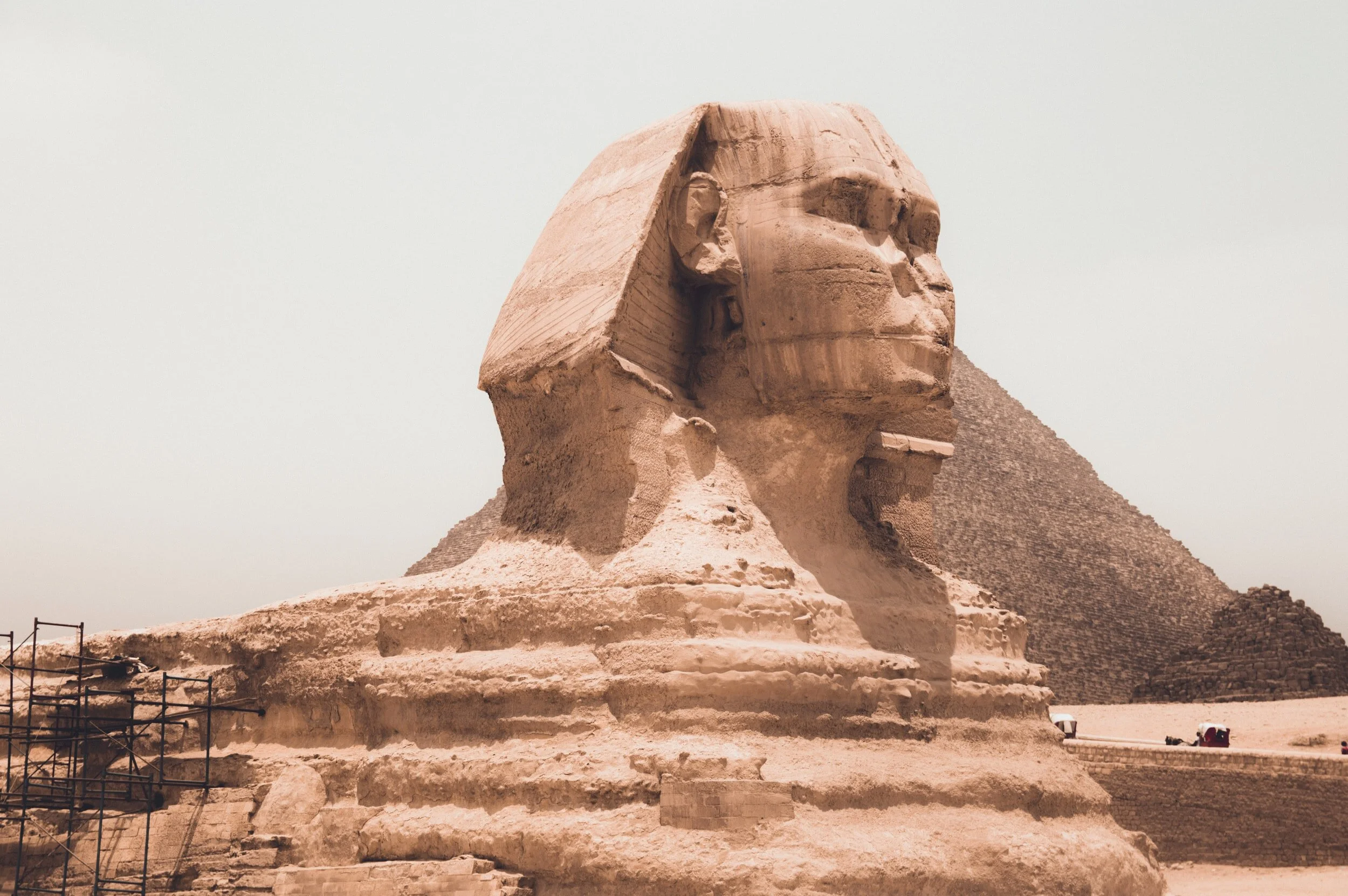
The fall of Egypt. The Egyptian god Thoth, of magic, wisdom, science, and intellect tells the divine servant, Asclepius, of the nature of the cosmos, of God, and of the cycle between life and death.
Who was Thoth? Thoth was the Egyptian god of wisdom and intellect, the creator of writing and hieroglyphics, science and magic, and is the representative of the gods. He is depicted human-like, but with the head of a baboon, his most sacred animal. Though Thoth is interesting to research, we’re more concerned with his prophecy for Egypt, located in the Hermetic texts. Every god has slight differences but overwhelming similarities. Hermes, the god of flight, was the Greek equivalent to Thoth.
What were the Hermetic texts? They were the philosophical texts dedicated to the Hellenistic figure Hermes Trismegistus, found in pagan circles like Syria and Mesopotamia who never had to endure the rise of Christian Fascist suppression, which escaped Muslim persecution by the artful device of inventing or becoming the religious group known as the Sabians, named in the Koran, hence deserving of respect, as Sabians mean ‘people of the book’. Eventually, the documents ended up in Constinapole. ‘‘The work is basically a dialogue in question and answer form. The two chief interlocutors are the god Thoth and a disciple ‘who wished to know.’ Another God, seemingly Osiris, also speaks with a disciple. This literary frame might suggest a comparison with the Greek Hermetic writings, which are also teaching dialogues between Hermes-Thoth and disciples. This comparison would appear all the more legitimate than in the Demotic text, Thoth is once called wr wr wr, ‘the thrice great one’. ‘‘
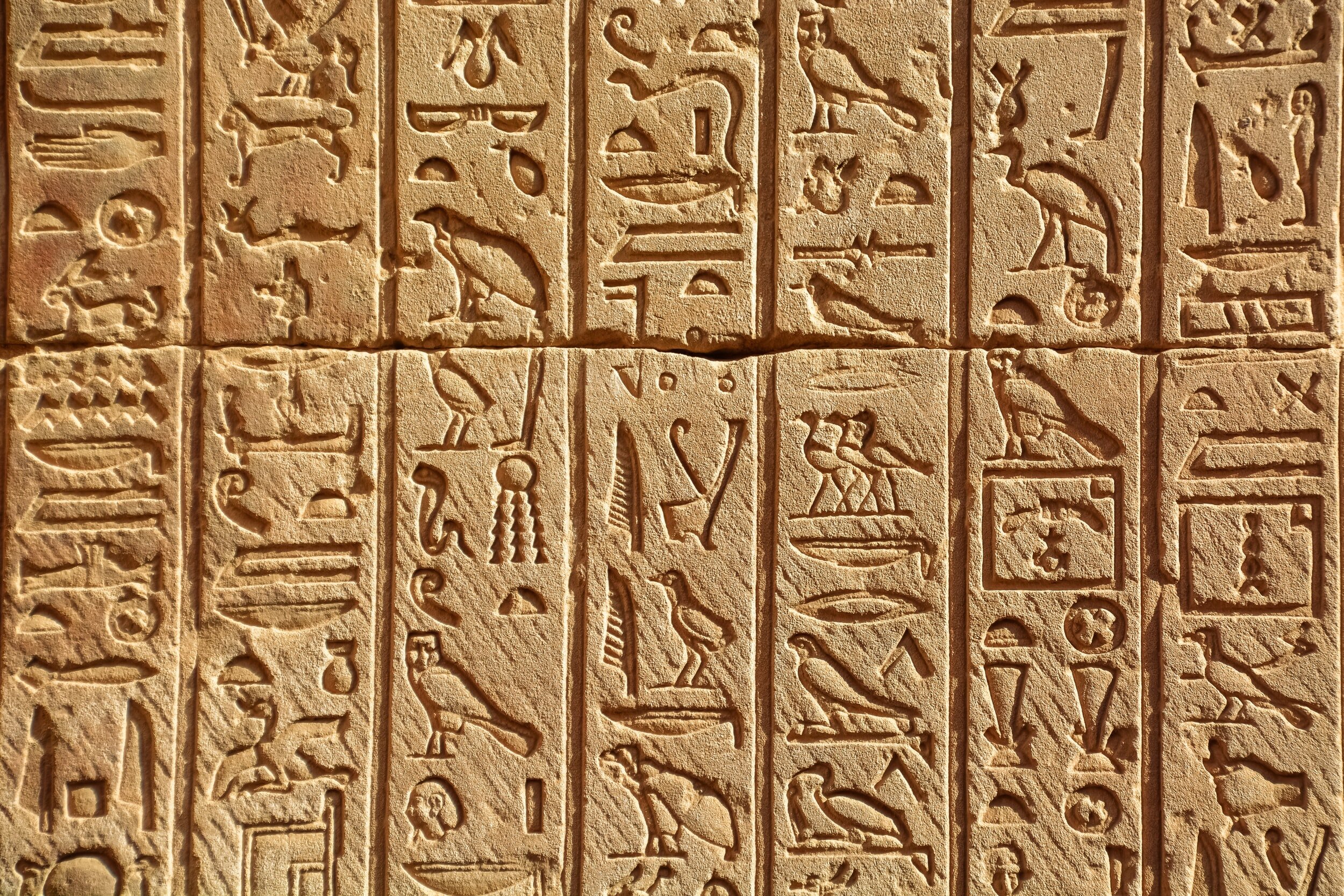
Thoth’s prophecy is a description of the nature behind cosmology, on the nature of God, the cycles of life, and the nature of the world. Every culture has what is commonly expressed as philosophical teachings; sometimes they are shared, like Greece and Egypt. Except this Egyptian content was created more than 2,500 years before Greece’s literature on philosophy. ‘‘The Hermetica as a whole is plainly a product of Greek culture in Egypt. The famous case from Edfu of Thoth, the Egyptian Hermes, introducing himself and establishing his direct descendent from the supreme god Ra. In short, the occurrence of the ‘I am..’ formula in a text from Egypt is immediately suggestive of native religious traditions.’’ But what does the prophecy entail? Why the doom of Egypt of course. An excerpt from Acclepius III spins the tale of the fall of the city, of the people, of the gods, and of their empire.
‘‘Nay, it should rather be said that the whole Kosmos dwells in this our land as in its sanctuary. And yet, since it is fitting that wise men should have knowledge of all events before they come to pass, you must not be left in ignorance of this: there will come a time when it will be seen that in vain have the Egyptians honored the deity with heartfelt piety and assiduous service; and all our holy worship will be found bootless and ineffectual. For the gods will return from earth to heaven; Egypt will be forsaken, and the land which was once the home of religion will be left desolate, bereft of the presence of its deities. This land and region will be filled with foreigners; not only will men neglect the service of the gods, but ...; and Egypt will be occupied by Scythians or Indians or by some such race from the barbarian countries thereabout. In that day will our most holy land, this land of shrines and temples, be filled with funerals and corpses. To thee, most holy Nile, I cry, to thee I foretell that which shall be; swollen with torrents of blood, thou wilt rise to the level of thy banks, and thy sacred waves will be not only stained but utterly fouled with gore. Do you weep at this, Asclepius? There is worse to come; Egypt herself will have yet more to suffer.’’

The tricksters
Those characters are always up to mischief. It’s not necessarily a bad thing, of course. Sometimes you need to start trouble in order to inspire change. Those who carry the title of ‘the trickster’ are usually seen in a bad light because of their actions, which if you read some of the myths about these archetypes, can sometimes be nefarious at best, but they usually teach social, ethical, and political values through puzzles, games, or twists of fate. A trickster can be an animal, spirit, or sometimes a god.
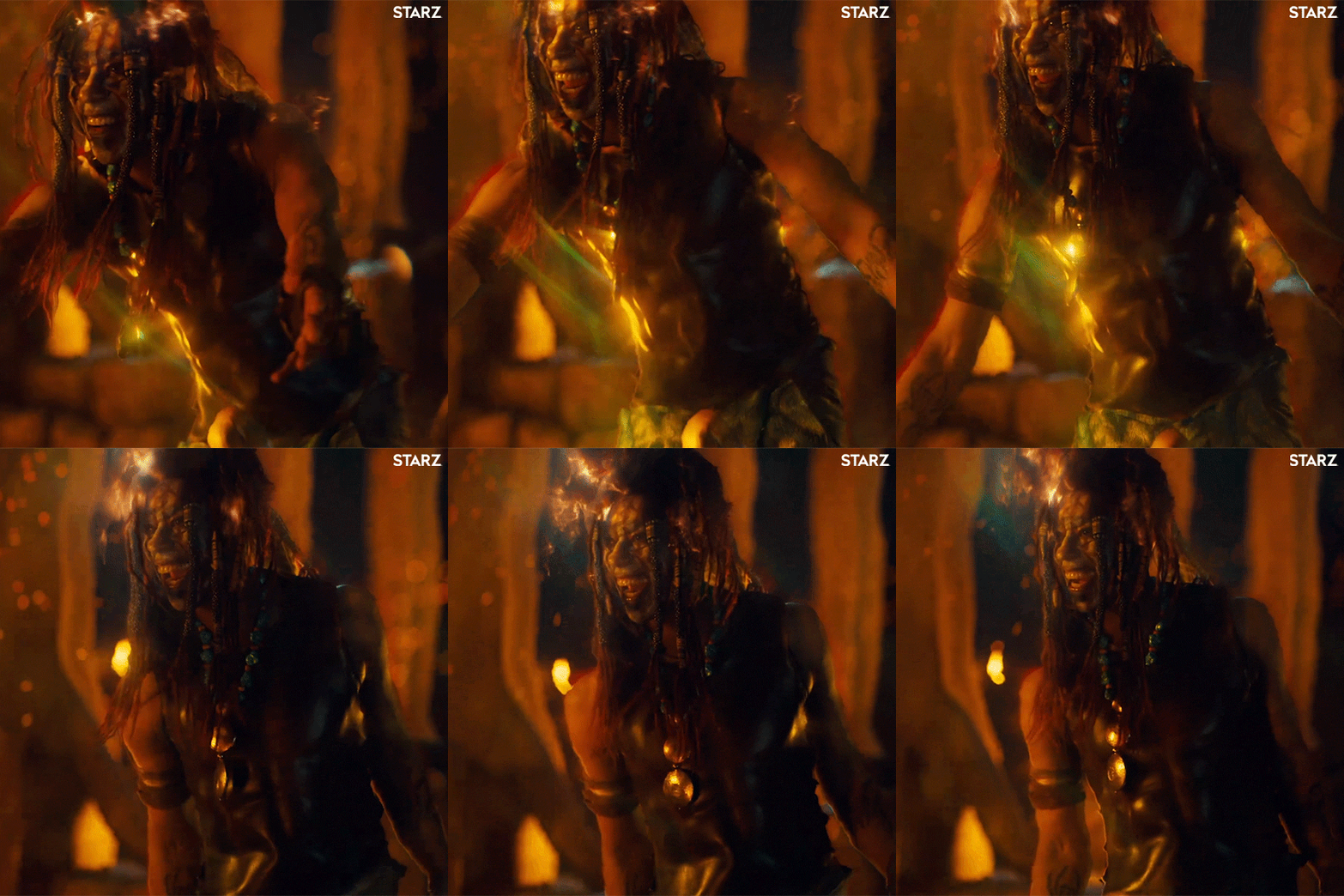

This particular trickster, which is very popular with the show American Gods on Starz, is the god Anansi, generally referred to as the god of stories of West African mythology. My favorite myth is how he got that title. The story goes as follows, Anansi the spider threw a web up into the sky, to confront the sky god Nyame, asking him to share all the stories of the world. So Nyame gives Anansi a challenge: If Anansi could bring to Nyame’s court Python the snake, Cheetah the fanged, the nests full of Hornets, and the fairy Mmoatia, then Anansi can have the box of stories. So Anansi agrees to this deal, thinking up new and clever ways to get the creatures to the sky court over the next four days. With the help of his wife Aso, and his son Ntikuma, Anansi goes into the forest to look for Python, and, waving a big stick in the air proclaimed that the stick was much longer than the Python. The Python slithered from the branch over their head, slithered down and stretched it’s long body alongside it, so that Anansi could easily wrap his strongest web around the thrashing web, then turned the big snake over to the sky god. Next, was the capture of the Cheetah. Appeasing to it’s ego, Anansi got a basket and claimed that the Cheetah was too small for it, but the Cheetah, undeterred, tried it on for size. Anansi quickly tied the bag around him, and dropped it off at the sky court, going after the hornets next. To catch the hornets, Anansi and his son go back into the forest, and carrying two big jugs of water, a empty gourd, and rope, they find the hornets nest, where very quietly they lift up both buckets and dump the water into the nest. The hornets, aggravated, came swarming out which brings Anansi to hold open the gourd, which he then sealed over and sent again to the sky court.
The final task that plagued Anansi was how to trick Mmotia, who was magic, into the sky court. His wife Aso had them both carve a wooden doll, and cover it in thick layer of sap from the nearby gum tree. Then they put the doll in a nice clearing and waited a long time. Then, they heard Mmotia scream at the doll because she thinks the doll is another fairy. Because it’s a doll, and is unresponsive, Mmoatia smacks it, claiming the doll’s rudeness. The doll’s sap causes Mmoatia’s hand to get stuck, and soon enough Anansi can bring a stuck Mmoatia to the sky court, winning the box of stories from a displeased Nyame, who didn’t believe he would win, and took it back to Earth. There goes the story of Anansi and the Box of Stories.